
Brief Description of the Report
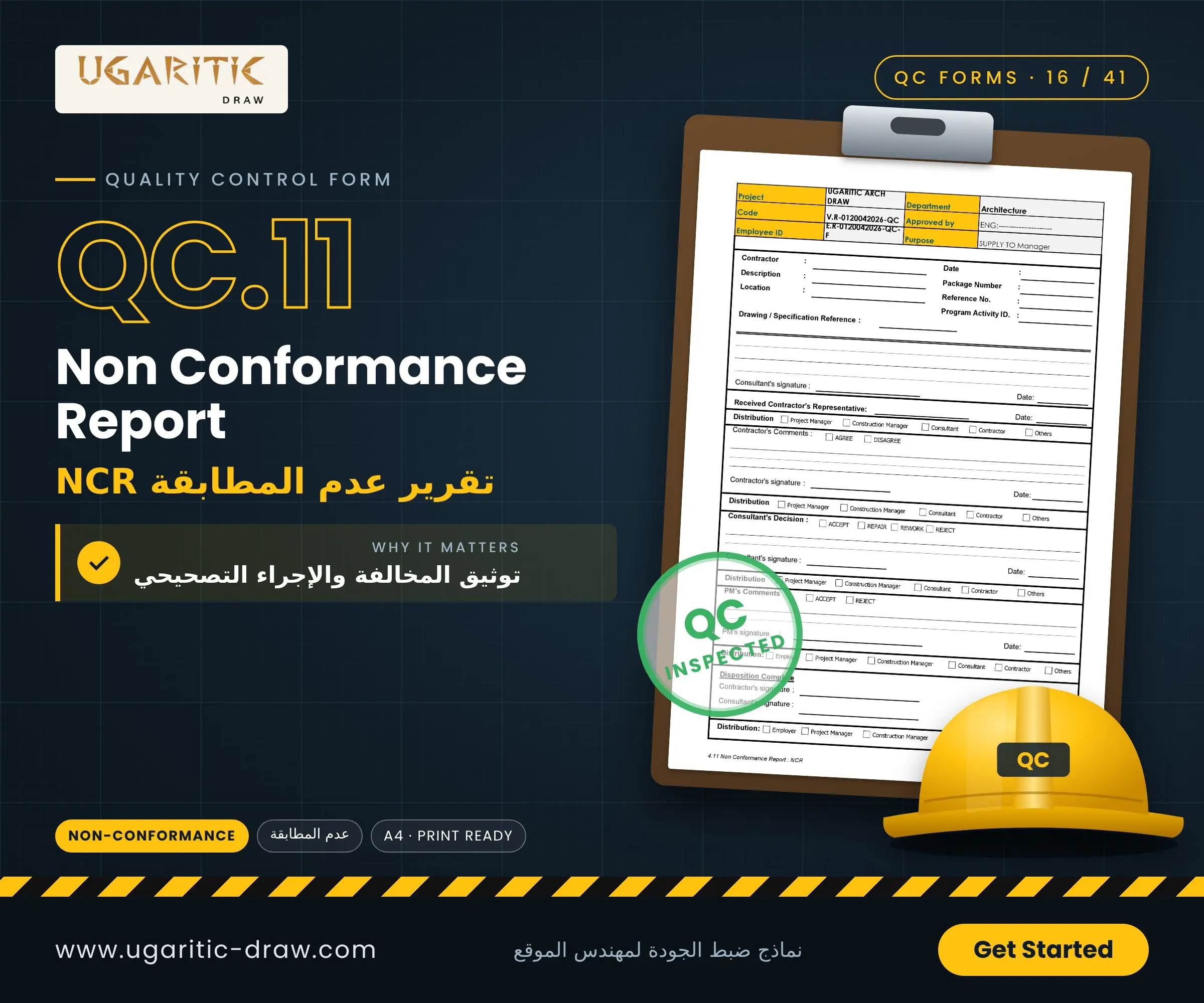
The document is a highly structured administrative form designed to track the entire lifecycle of a construction violation through the following sections:
- Technical Violation Data: Fields to define the contractor, exact description of the non-conformance, its precise location, and the violated drawing or specification reference, signed off by the consultant to initiate the report.
- Contractor's Comments: Allows the contractor to state their position by checking either "AGREE" or "DISAGREE" regarding the violation, along with their technical justification and signature.
- Consultant's Decision: The consultant dictates the mandatory corrective action using four definitive checkboxes:
- ACCEPT: Accept the non-conformance as-is (usually with a penalty or justification).
- REPAIR: Fix the specific issue.
- REWORK: Redo the entire portion of work from scratch.
- REJECT: Total rejection and removal of the work.
- PM's Comments: The Project Manager steps in to provide the final commercial and administrative endorsement by checking "ACCEPT" or "REJECT".
- Disposition Complete (Closure): The final sign-off section where both the contractor and consultant sign to officially certify that the violation has been resolved and the report is closed.
2. Purpose of the Report
The primary purpose of a Non-Conformance Report (NCR) is to identify, formally document, and rectify major engineering deviations to prevent any substandard work from compromising the project's safety and quality. Its key objectives include:
- Safeguarding Project Quality: Immediately halting unauthorized construction methods or materials and legally forcing the contractor to fix them.
- Defining Governance & Accountability: Distributing authority transparently—the consultant evaluates technically, the Project Manager signs off administratively/financially, and the contractor executes obligatorily.
- Contractual & Legal Protection: Serving as a vital legal record that protects the owner's rights if the violation leads to financial penalties, project delays, or structural issues in the future.
- Cross-Departmental Tracking (Distribution): Keeping all stakeholders completely aligned—including the Employer, Project Manager, Construction Manager, Consultant, and Contractor—to ensure the critical issue is thoroughly tracked until closure.