

1. Brief Description of the Report
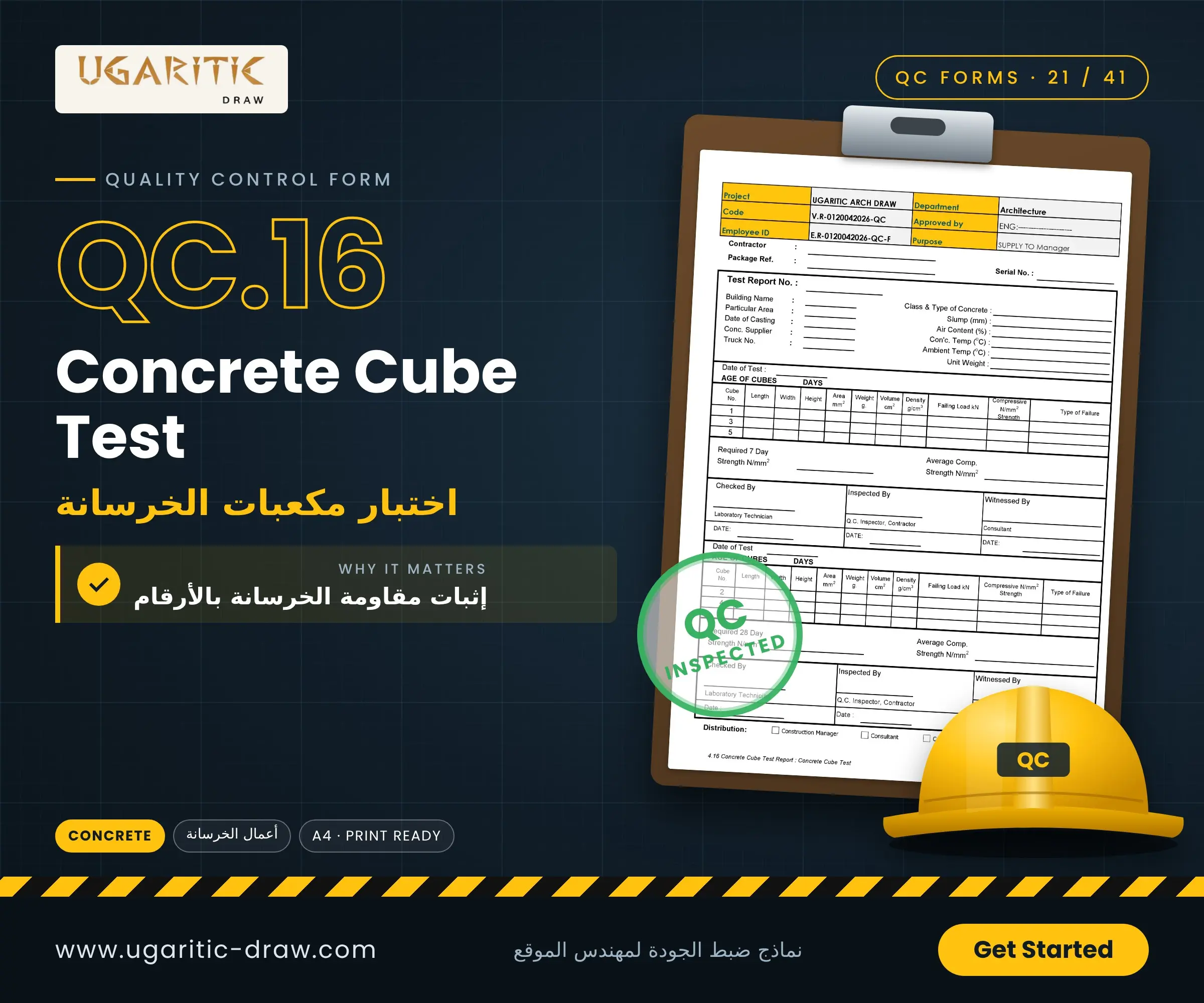
The document is a standardized laboratory test result sheet designed to log the physical and mechanical properties of concrete specimens. It consists of the following key sections:
- Pouring & Site Reference Data: Fields to record the Test Report Number, Building Name, Particular Area, Concrete Supplier, and the mixing truck number (Truck No).
- Fresh Concrete Properties: Dedicated fields to document the Class & Type of Concrete, Slump test measurements (mm), Air Content (%), Concrete and Ambient Temperature (°C), and Unit Weight.
- Specimen Evaluation Tables (7-Day and 28-Day Age): Analytical matrices to measure individual concrete cubes (Length, Width, Height, Area, Weight, Volume, and Density), along with the ultimate load at which the cube breaks (Failing Load kN), the resulting Compressive Strength N/mm², and the Type of Failure.
- Sign-off & Witness Block: Authentication fields requiring individual validation from the Laboratory Technician, the contractor's Q.C. Inspector, and the Consultant acting as an official witness (Witnessed By).
2. Purpose of the Report
The primary purpose of this report is to verify that the concrete poured on-site has reached its required structural design strength to safely bear the building's engineering loads. Its core objectives include:
- Verifying Structural Integrity: Confirming that the concrete's compressive strength at 7 days (as an early indicator) and at 28 days (the final design strength) meets or exceeds the structural values approved in the project specifications.
- Formal Acceptance or Rejection of Works: Relying on the values recorded in the Average Compressive Strength field to officially accept the concrete element or flag it for non-destructive testing (such as Schmidt Hammer or Core Drill testing) if the results fall below specifications.
- Supplier Quality Auditing: Continuously monitoring the performance of the concrete batching plant to ensure they deliver a uniform and compliant mix design throughout the project's construction lifecycle.
- Legal Quality Records (Distribution): Preparing an official, binding quality record distributed among the Construction Manager, Consultant, and Contractor to be safely archived inside the final project closeout file (As-Built Documentation).