

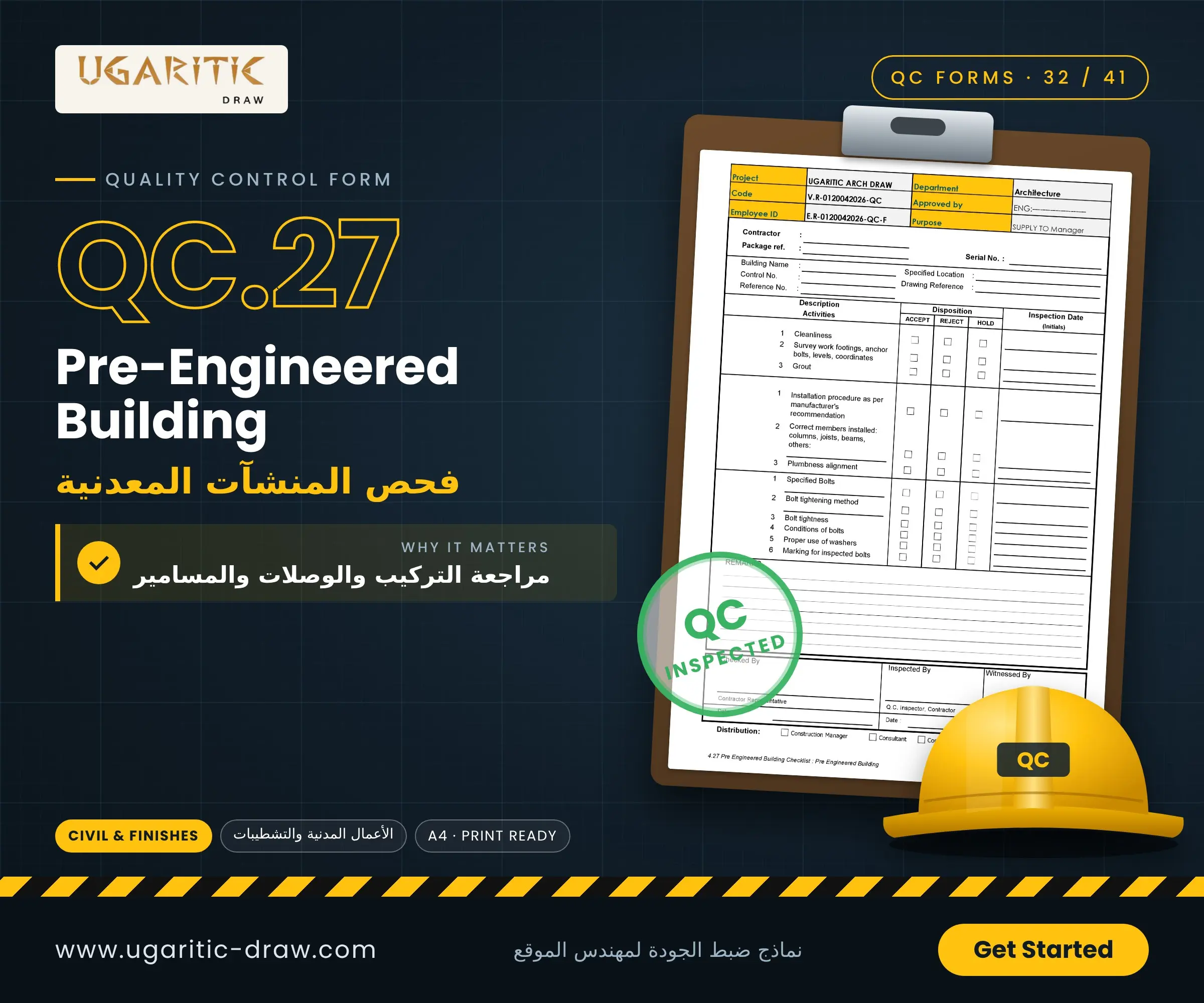
1. Brief Description of the Report
The document is a standardized technical field audit checklist organized into sequential structural phases to monitor the assembly of steel frames. It consists of the following key sections:
- Site Reference & Structural Profiling: Fields to specify the Contractor's name, Package Reference, Building Name, Specified Location of the frame erection, and the approved Drawing Reference.
- Core Technical Inspection Modules:
- Sub-Structural Foundation Prep: Verifying the base concrete Cleanliness, auditing the topographical alignment of foundation footings, anchor bolts, levels, coordinates, and inspecting the structural non-shrink cementitious Grout poured under the base plates.
- Steel Frame Erection: Reviewing the field Installation procedure as per manufacturer's recommendation, verifying that the correct members are installed (including columns, joists, beams, others), and conducting rigid verticality checks (Plumbness alignment).
- Structural Fasteners & Bolting Assembly: Auditing the utilization of Specified Bolts, verifying the approved Bolt tightening method, measuring structural Bolt tightness, evaluating the physical Conditions of bolts, ensuring the Proper use of washers, and applying physical Marking for inspected bolts to ensure complete traceablity.
- Actionable Evaluation Matrix & Validation: Side-by-side compliance checkboxes for every sub-item offering three paths: ACCEPT, REJECT, or HOLD, followed by a wide space for general technical Remarks and the mandatory multi-party validation signatures from the contractor, QC inspector, and consultant.
2. Purpose of the Report
The primary purpose of this checklist is to field-verify that the pre-engineered structural steel framework is erected to exact dimensional alignments and fastening torques to preserve its load-bearing capacity and eliminate collapse risks. Its core objectives include:
- Enforcing Flawless Verticality and Axial Alignment: Rigorously auditing the structural Plumbness alignment; because any structural tilt or lean in heavy steel columns or joists introduces unintended eccentric forces, which directly threatens the building's stability against wind and live loads.
- Guaranteeing Connection and Fastening Integrity: Closely monitoring high-strength Bolts, their tightening methods, and Washers to ensure that critical moment and shear connections remain entirely fixed, preventing structural warping under operational vibration or live loading.
- Validating Load-Transfer Footings and Anchors: Ensuring that the sub-structural foundation interfaces (Anchor bolts and Grout) are perfectly level and soundly consolidated before frame assembly, ensuring smooth dead-load transfers into the ground.
- Quality Records & Handover Archival (Distribution): Storing a legally binding structural certification distributed to the Construction Manager, Consultant, and Contractor to update the final project closeout quality log.