

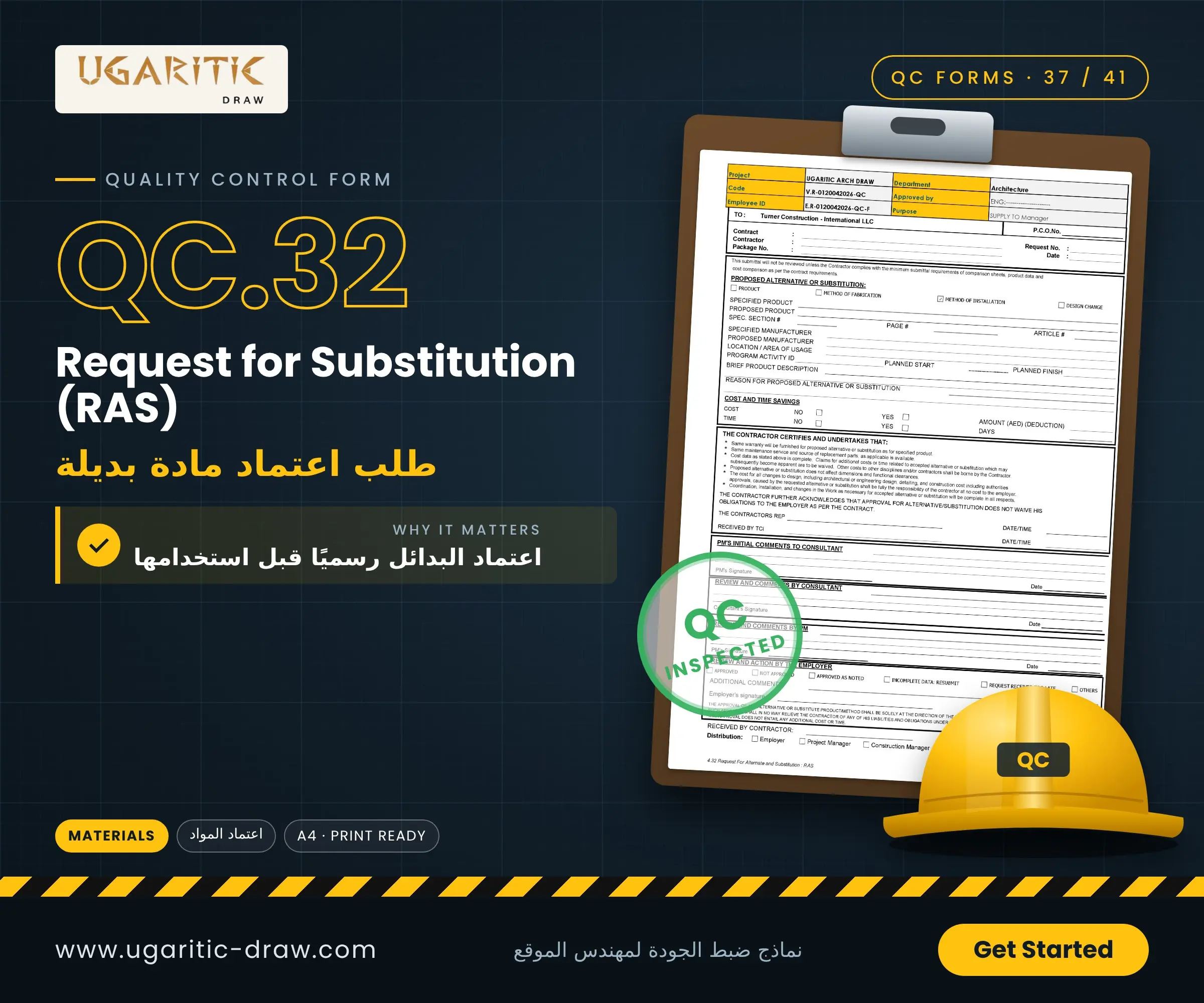
1. Brief Description of the Report
The document is a comprehensive administrative and change-management form engineered to route commercial alterations through a strict multi-tiered review cycle from the contractor up to the client [M9nYaQ]. It consists of the following key sections:
- Proposed Alternative or Substitution Profiling: Feature checkboxes to classify the exact nature of the change: PRODUCT, METHOD OF FABRICATION, METHOD OF INSTALLATION, or DESIGN CHANGE [M9nYaQ]. It includes matching rows to compare the specified product directly against the proposed alternate, referencing the specific project SPEC. SECTION #, PAGE #, and ARTICLE # [M9nYaQ].
- Cost and Time Savings (Commercial Impact): A vital financial ledger to declare whether the substitution yields a credit back to the owner (COST YES/NO), detailing the exact credit valuation as an AMOUNT (AED) (DEDUCTION), or optimization in schedule (TIME YES/NO) measured in DAYS [M9nYaQ].
- Contractor Certification and Undertaking: A legally binding statement where the contractor certifies that the substitution carries the same warranty, identical maintenance source, maintains architectural clearance tolerances, and that the contractor bears all coordinate costs without altering contractual obligations [M9nYaQ].
- Sequential Governance Review Matrix: Dedicated commentary and authorization sections to capture progressive approvals from:
- PM's Initial Comments to Consultant: Preliminary management review [M9nYaQ].
- Review and Comments by Consultant: Technical and engineering compliance vetting [M9nYaQ].
- Review and Comments by PM: Financial and contractual endorsement [M9nYaQ].
- Review and Action by the Employer: The final executive decision matrix where the client marks the request as APPROVED, NOT APPROVED, APPROVED AS NOTED, INCOMPLETE DATA: RESUBMIT, or REQUEST RECEIVED TOO LATE [M9nYaQ].
2. Purpose of the Report
The primary purpose of this request form is to govern, legally document, and track any material or design deviations from the original contract to ensure project quality is preserved while officially capturing financial credits or schedule advantages for the client. Its core objectives include:
- Enforcing Value Engineering Protocols: Providing a transparent, formal pathway for the contractor to propose alternative construction materials that deliver equal or superior performance at a lower cost, legally passing the financial savings back to the client (Employer) as a documented credit deduction [M9nYaQ].
- Adapting to Field Execution Constraints: Allowing the contractor to officially modify a Method of Installation or fabrication when physical site constraints arise, ensuring changes are engineered safely without triggering arbitrary contract breaches [M9nYaQ].
- Mitigating Commercial Frauds and Legal Liabilities: Preventing the contractor from unilaterally installing unapproved materials on-site; it ensures that the technical liability is cross-checked by the consultant, the commercial impact is verified by the PM, and the final risk is accepted by the owner [M9nYaQ].
- Updating Project Baselines and As-Builts (Distribution): Instantly routing the final executive decision to all stakeholders (Employer, Project Manager, Construction Manager, Consultant, and Contractor) to update procurement registers, bill of quantities (BOQ), and site manuals [M9nYaQ].